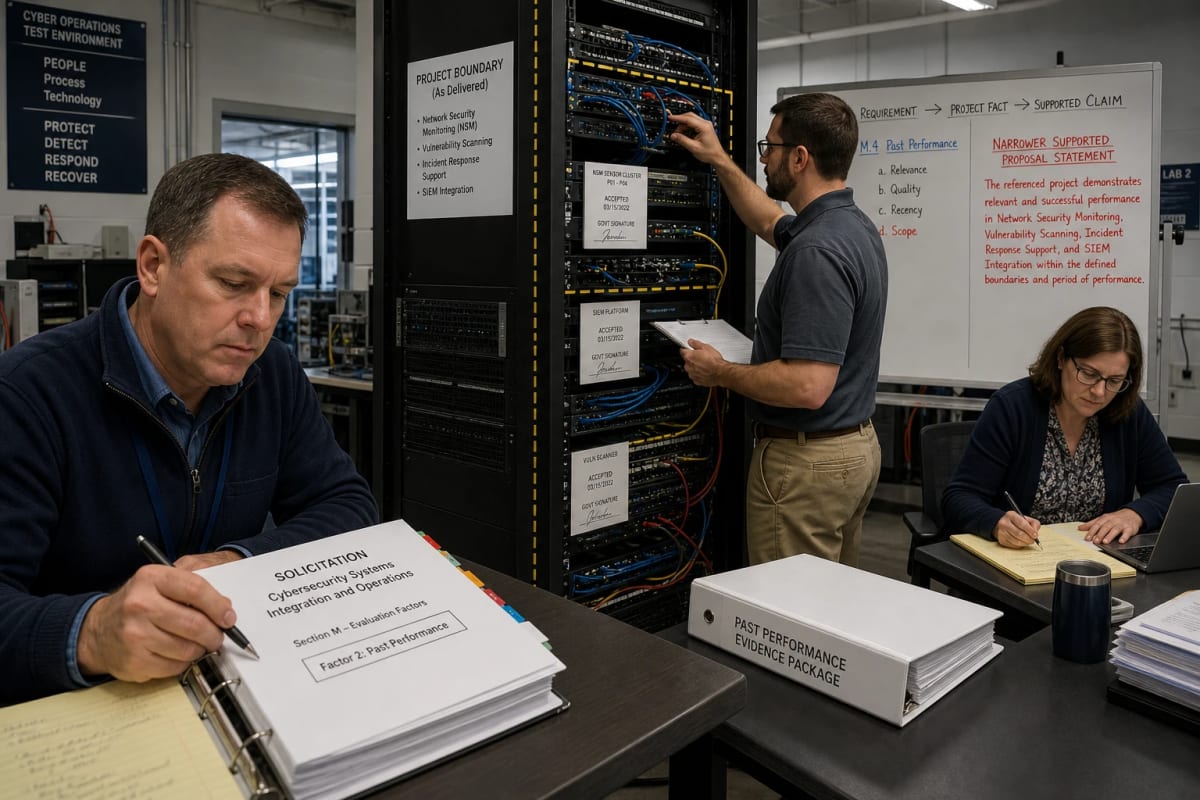
The Plausible but Risky Myth
The common belief is understandable: if a prior contract occurred in the same agency, mission area, or industry, it should count as a strong past-performance match. Capture teams are under pressure to make a pursuit look compelling, and familiar agency language seems to make that work easier. A cybersecurity support contract, for example, may look close to a new cybersecurity operations requirement at first glance. But broad similarity is not the same as evidence that the prior work directly addresses an evaluation factor.
The failure point arrives when a proposal claims the old project delivered the same scope, scale, complexity, and outcomes as the new requirement, but the contract record tells a narrower story. Perhaps the old work supported 40 users while the solicitation calls for enterprise-wide operations. Perhaps it provided staff augmentation while the new requirement evaluates managed service delivery, transition planning, and measurable service levels. The evaluator is not required to infer equivalence from a shared label.
A credible partial match is stronger than a perfect match that cannot survive review.
Why Credibility Matters Now
Past performance is where a contractor’s narrative meets a customer’s ability to verify it. Evaluators may compare proposal statements with questionnaires, contractor performance records, references, contract documents, and their own knowledge of the work. A claim that stretches beyond those materials creates a credibility problem that can color the rest of the volume. The issue is not merely whether a project was successful, but whether the proposal describes it precisely.
The stakes are sharper for small businesses because federal prime-contractor participation has been declining even while small-business spending remains significant. Deltek describes a market where the pool of participating small-business primes has continued to shrink. In a tighter field, a proposal that is clear about what it has done can be easier to trust than one that tries to sound interchangeable with every competitor. Credibility preserves the value of experience that is genuinely distinctive.
Automation and AI can organize project files, extract requirement language, and draft a comparison for review. They should not decide that experience is relevant or certify that a claim is supported. Procurement guidance still treats these tools as decision support because contract interpretation, supplier judgment, and compliance review require human accountability. Your team should use technology to reduce searching, not to replace the person who must defend the assertion.
Start With Evaluation Factors

Begin with the evaluation factor, not with the resume of projects your team wants to feature. Read the relevant solicitation language and identify what the government says it will assess, such as experience operating a specific environment, delivering a defined service, or achieving a stated result. Then ask one narrow question: does this project directly provide evidence for that factor? This prevents a pursuit meeting from becoming a general discussion of everything the company has ever done.
A factor about managing a transition is not answered simply because the contractor has performed ongoing operations. A factor about working in a classified environment is not automatically answered by work for a defense-related customer. A factor about measurable response times is not answered by a statement that the customer was satisfied. Each claim needs to address the work the evaluator is actually being asked to score.
Your initial review should separate the factor into checkable elements before anyone starts drafting. The following questions keep the discussion anchored to evidence rather than optimism:
- What service or deliverable does the factor require?
- What operating environment or customer context matters?
- What scale or technical complexity is explicit?
- What result, quality standard, or management responsibility is being evaluated?
Test the Actual Dimensions
Industry similarity is a starting point, not a conclusion. A practical review compares the old project and new solicitation across the dimensions that change the difficulty of performance. Those dimensions include scope, customer, contract type, scale, complexity, operating environment, and measurable results. A project can be highly relevant on three dimensions and materially different on two others.
Scope asks what was actually delivered, not what adjacent work the contractor was capable of delivering. Customer asks whether the mission, stakeholder structure, and operating expectations are comparable. Contract type can matter because performing under a fixed-price outcome obligation is different from providing labor under a time-and-materials arrangement. Scale includes workload, user population, locations, assets, transaction volume, or staffing only when the record supports the stated measure.
Complexity is often the most abused dimension because it is easy to describe and difficult to prove. Treat complexity as specific conditions: a multi-site rollout, integration with named existing systems, a compressed transition, regulated data handling, or around-the-clock coverage. The environment should likewise be concrete, such as a field setting, a secure facility, or a civilian enterprise network. Results require a documented measure, accepted deliverable, performance rating, or reference-supported outcome.
Classify Every Claimed Match

Not every project needs to be a direct match to earn a place in the proposal. The important discipline is to label the relationship honestly so reviewers and writers make the same decision. Direct matches support the requirement as stated, partial matches support a defined portion, and transferable experience shows a relevant capability in a different context. These categories prevent a team from turning useful evidence into an unsupported equivalency claim.
A direct match might be a project that operated the same service for a comparable customer population and produced the result the factor names. A partial match might show the same technical service but at a smaller scale, with the scale difference stated plainly. Transferable experience might show a proven transition method from another environment without claiming that the environments were identical. Each category can contribute value when the proposal explains its purpose.
Use a stricter label when the match has an important difference in any of these areas:
- The project delivered only one part of the requested scope.
- The customer setting imposed different mission or compliance demands.
- The contract placed different responsibility for outcomes on the contractor.
- The documented scale or result is smaller, narrower, or unavailable.
The label is not an admission of weakness. It is a drafting instruction that tells the team what it may claim and what it must explain.
Build an Evidence Matrix
An evidence-based past-performance matrix turns a subjective debate into a reviewable record. Give each project-factor pairing its own row, then record the exact claim the proposal intends to make. Next to that claim, identify the proof: a contract deliverable, customer reference, performance record, project report, or verified metric. If the team cannot point to proof, the statement is a capability assertion, not past-performance evidence.
The matrix does not need complicated scoring. It needs enough detail that a reviewer can see the path from solicitation factor to project fact to proposal sentence. Record the source location and the owner who can validate the information before the narrative reaches final review. This is especially useful when a proposal team is working from scattered files, old slides, and individual memory.
A useful row should capture four things without burying the reviewer in paperwork:
- The specific evaluation element being addressed.
- The project fact and the approved evidence source.
- The match type: direct, partial, or transferable.
- The difference that must be disclosed or avoided in drafting.
That structure also makes it easier to remove attractive claims that have no support before they become expensive rework.
Use Solicitation Language Carefully
Mirroring solicitation language is useful only when the old work genuinely supports the same words. If the requirement evaluates enterprise service management, do not use that phrase for a help desk project unless the project records show the broader management responsibility. If the requirement calls for measurable outcomes, state the documented outcome rather than copying the target measure without evidence. Familiar wording earns attention; unsupported wording earns scrutiny.
Writers can preserve relevance by pairing the solicitation term with a precise qualifier. Instead of saying the contractor “managed enterprise operations,” say it “provided operations support for the agency component’s 1,200-user environment,” if that number and scope are documented. Instead of claiming a “full transition,” say the team “completed the transition of the reporting workflow” when that was the actual deliverable. Precision is persuasive because it gives the evaluator something concrete to assess.
Watch for words that quietly expand the project beyond the record, including “same,” “identical,” “enterprise-wide,” “end-to-end,” and “exceeded.” These terms may be appropriate, but each one carries a factual burden. Your reviewer should be able to ask, “Where is that shown?” and receive an immediate answer. If the answer is personal recollection or a vague slide, narrow the claim.
Explain Gaps Without Apology

Gaps do not disappear because a proposal omits them. When the difference is material and likely visible to an evaluator, address it in one controlled sentence. State what the prior work did prove, name the boundary, and explain why the experience remains relevant to the specific factor. That approach is more credible than an overlong defense or an unsupported claim of equivalence.
Consider a contractor whose prior work supported a regional deployment while the new solicitation covers nationwide operations. The proposal can say the project demonstrated the same deployment method, governance process, and stakeholder coordination model, while accurately stating the regional scope. It should not claim nationwide delivery unless the contract evidence supports it. The proposal may then use a separate, supported project to address national scale if one exists.
This distinction matters most when the gap concerns outcomes. A project can show sound execution even when it lacks a documented cost reduction, availability rate, or response-time result. In that case, use accepted deliverables, performance feedback, or documented completion milestones instead of inventing a success metric. Honest evidence is still evidence.
Make Review More Reliable
Past-performance review often breaks down because claims are drafted before project facts are assembled. The proposal then becomes the working record, and every late correction affects graphics, resumes, management plans, and executive review. A short evidence review before drafting reduces that churn. It also gives technical staff a clear way to challenge a claim without turning the meeting into an argument about writing style.
Your team should assign one person to validate contract facts and one person to test relevance against the evaluation factor. The validator confirms what happened, while the relevance reviewer decides how far the proposal can reasonably go. Neither role should rely solely on an automated summary or a boilerplate project description. Separating the jobs makes unsupported expansion easier to catch.
Three Sixty Vue’s Contract Intelligence system can help teams shortlist solicitations for review and create briefs that show the information behind an opportunity match. That supports earlier capture decisions, but the final judgment about past-performance relevance still belongs with the people who know the contract record and the solicitation. Use the brief to focus the review, then use the matrix to substantiate the proposal. The goal is faster preparation without weaker judgment.
The Corrected Mental Model
The corrected mental model is simple: past-performance fit is not a claim of similarity, but a chain of proof. The chain begins with the evaluation factor, moves through specific project facts, and ends with a carefully bounded proposal statement. A direct match should be called direct because the record supports it. A partial match should be called partial because clarity preserves trust.
This approach does not make your experience smaller. It makes each relevant accomplishment easier for an evaluator to believe and easier for your team to defend. It also reveals where a pursuit depends on transferable experience, a teammate’s record, or a decision not to overinvest in a weak fit. The strongest proposal is not the one that says every project was the same as the requirement. It is the one that makes the real match impossible to miss.