
Why the Myth Persists
The common belief makes sense at first: if AI can summarize a 200-page contract, surely it can reliably extract a due date, contract number, or line-item total. Demonstrations often use clean digital files with obvious labels and orderly tables. In that setting, extraction can look nearly automatic. The problem begins when a real document package includes scans, amendments, exhibits, spreadsheets, and pages created by different organizations.
This matters because document fields often trigger real operational decisions. A wrong submission date can put a pursuit team behind before review begins, while a missed clause can affect pricing, compliance, or a bid decision. Invoices and subcontractor records carry similar risk when extracted totals or payment terms are accepted without checking. The expensive failure is rarely that a system cannot read a page; it is that it presents a wrong answer with enough confidence to be trusted.
Operations leaders are also under pressure to connect work across systems rather than automate isolated clicks. 2026 workflow discussions increasingly describe automation as orchestration across data, tools, people, and process stages, not a single task running in isolation. That direction is useful, but it raises the stakes for bad source data moving quickly through connected systems. An extraction step must therefore be designed as one controlled part of a workflow, not treated as the final authority.
Extraction Is Not Understanding
Document extraction has two distinct jobs that are often confused. First, software has to identify characters from an image or digital file, a process commonly called optical character recognition. Then it has to decide which characters belong to the requested field and what that field means. A system may read every word correctly and still assign the wrong date to the wrong requirement.
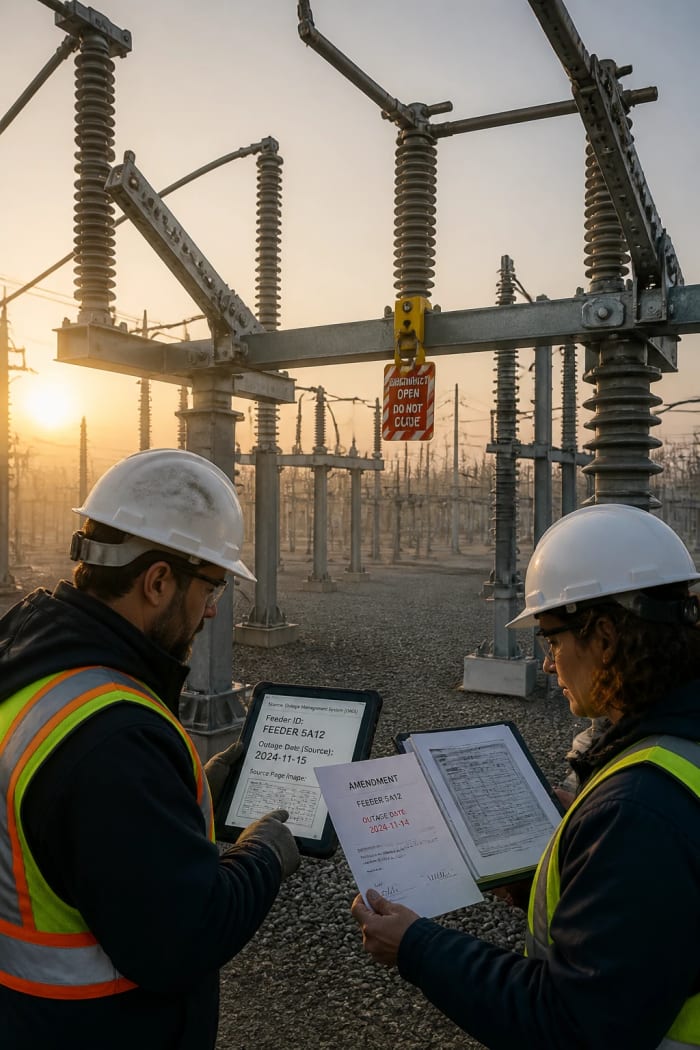
Consider a solicitation with an original response deadline, an amendment date, and a revised closing date on different pages. Reading those dates is not especially difficult when the text is visible. Determining which date governs the current submission is a context decision that depends on labels, amendment language, and sometimes the relationship among documents. That is closer to document interpretation than simple extraction.
Hidden assumptions also cause confusion when teams ask for an accuracy number. A claimed accuracy rate may measure whether the software found text, whether it captured a field, or whether the field matched a human-approved answer. Those are different tests with very different consequences. Before comparing tools, your team needs to define what a correct answer means for each field that matters.
Documents AI Handles Well

Start with fields that can be checked against a simple business rule or another system of record. A purchase order number can be matched to an existing record, and a total can be compared against line items or a tolerable range. These checks catch errors that a model may state confidently. The following conditions are usually favorable for early automation:
- Digital documents with selectable, legible text
- Repeatable templates from the same source
- Clearly labeled fields with predictable meanings
- Values that can be checked against a database or rule
Even strong candidates need an exception path. A vendor can change an invoice template, an agency can issue an amendment, or a scanned attachment can appear in an otherwise clean package. Automation should route those cases for review instead of forcing a guess into a required field. That small design choice protects the time savings from turning into rework.
The PDF Can Mislead
A PDF is a container, not a guarantee that the document is machine-readable. One file may contain real text, while another is only page images created by a scanner. A third may have an invisible text layer that does not align with the visible page, often because prior conversion software guessed at the characters. Each version can look identical to a person opening the file.
Low resolution, faint type, skewed pages, seals, signatures, and compression artifacts make character recognition less reliable. A zero can become the letter O, a decimal point can disappear, and a section number can be split across lines. These are not necessarily failures of the language model interpreting the document. They may originate before interpretation, when the system is trying to turn pixels into text.
Your team should preserve the source page and make it easy for a reviewer to compare an extracted value with the original. That means recording the page location, retaining the file version, and avoiding workflows that overwrite the source with cleaned text alone. If the result cannot be traced back to a visible page, it is difficult to correct and even harder to defend. Traceability is especially important when a field affects a proposal decision or compliance obligation.
Layouts Break Reading Order
People read a page using visual cues that extraction systems do not always interpret the same way. A person knows a signature block belongs at the end, a column heading applies to the values below it, and a footnote can modify a sentence on another part of the page. Multi-column layouts, nested tables, sidebars, and callout boxes disrupt that reading order. The model may merge text that is visually adjacent but logically unrelated.

Do not judge table extraction by whether the output looks neat in a spreadsheet. Test whether relationships survive: does each quantity remain tied to its unit, description, rate, and period? Use real files with wide tables, continuation pages, merged cells, and revisions rather than a single ideal sample. If the relationships cannot be verified, automate only the intake and routing step. A clean-looking table is not proof of a correct table.
Context Creates Costly Errors
Some information is not stated in one labeled box. A contract may establish a requirement in one clause, modify it in an amendment, and qualify it in an attachment. A bid package may mention several locations, dates, and submission instructions that apply to different actions. Extraction can surface those passages quickly, but selecting the governing answer still requires a rule and sometimes a reviewer who understands the pursuit.
This is why confidently presented outputs deserve caution. A system may return a plausible NAICS code, period of performance, or response deadline because those values appear somewhere in the file. That does not establish that the field applies to the current solicitation, the current amendment, or your company’s decision. The practical question is not whether the value exists on a page, but whether it is the right value for the decision being made.
Fast extraction is useful. Unchecked interpretation is expensive.For high-consequence fields, require supporting evidence alongside the answer. A useful review screen shows the extracted value, the source snippet, the page number, and the reason the system selected it. That gives a capture lead a quick way to confirm a result instead of rereading an entire document. It also exposes when the system has found competing values that need human judgment.
Review Belongs in Workflow
Human review is not an admission that automation failed. It is a control point for documents whose uncertainty or consequence exceeds a defined threshold. Current automation thinking places increasing emphasis on security, governance, exception handling, and human oversight as more processes become connected. The useful comparison is not people versus AI; it is broad manual reading versus focused review of the records most likely to cause harm.
Build the review path before scaling volume. Decide who owns exceptions, how quickly they must respond, and what happens when a document conflicts with a system record. Then test whether the extracted result reaches the correct queue without being copied manually into several tools. Fragmented handoffs are a major reason automation projects create new work instead of removing it.
Measure Errors by Consequence
An overall accuracy percentage can hide the failure that matters most. Missing a low-value reference number and missing the final solicitation response deadline should not count the same. A better measurement approach groups fields by the consequence of being wrong. That helps the team spend review time where the risk is real.
For each high-consequence field, track the source document type, whether the file was digital or scanned, the extracted value, the verified value, and the correction reason. Patterns will soon show whether errors come from poor scans, table structure, source inconsistency, or the interpretation rule. This is more useful than blaming “the AI” whenever a result fails. It also provides evidence for deciding whether preprocessing or a new workflow rule will solve the actual problem.
Review time has an economic cost, but so does a bad automated decision. A reviewer spending two minutes confirming a closing date is cheap compared with a team discovering a deadline error after assigning proposal work. For low-risk invoice fields, a sampled quality check may be enough. For bid, contract, and compliance fields, verification should match the consequence, not the convenience of full automation.
Choose Automation by Risk
The right mental model is simple: automate recognition where the documents are predictable, automate validation where rules are clear, and reserve judgment for ambiguity. This is not a retreat to manual processing. It is a way to make automation dependable enough to use in operational decisions. The system should move work forward while making uncertainty visible.
Use a short intake decision before adding any document class to production. The decision does not require a technical scorecard, but it should force the right questions:
- Is the source text clear and consistently formatted?
- Can the most important fields be checked against a rule or record?
- What is the cost if the field is wrong?
- Who reviews exceptions, conflicting values, or low-confidence results?
For contractors, the safest early uses are usually document logging, basic classification, searchable summaries, and extraction of fields that a reviewer can verify quickly. A solicitation remains a request for offers, not an award, and extracted data should not blur that distinction. Likewise, a forecast, contract vehicle, award record, and agency record answer different questions and should not be treated as interchangeable sources. Good automation preserves those distinctions instead of flattening them into one confident-looking output.
What to Do This Week
Pick one document stream that creates repeated manual work, such as supplier invoices, subcontractor forms, or incoming opportunity documents. Collect a representative sample that includes clean files, scans, tables, amendments, and the awkward exceptions people usually avoid testing. Identify the two or three fields that cause the most rework or decision risk. That gives your team a real test set instead of an optimistic proof of concept.
Next, define the validation and review route before choosing a model. Set a rule for what can pass automatically, what requires evidence on screen, and what must be escalated to a person. Three Sixty Vue’s Automation Systems can connect existing tools, route extracted information, and make those follow-through steps more reliable when a custom workflow is the right fit. The service is most relevant when the issue is not merely reading a document, but getting verified information to the right owner and next action.
The corrected expectation is not that AI will understand every document like an experienced contract professional. It is that AI can reduce the amount of routine reading, organize evidence, and direct attention to the pages that deserve it. Document quality, layout, and context still set the limits. The strongest system treats those limits as design inputs, not inconvenient surprises.