
Automation Can Hide Bad Decisions
Automation makes routine work faster, but speed can conceal a poor decision path. A workflow may classify a document, copy fields between systems, assign an owner, and send a notification without anyone testing whether the result makes business sense. The risk is especially high when the workflow handles solicitation intake, compliance records, pricing inputs, or customer commitments. A wrong result that moves quickly can cost more than a delayed result that receives the right review.
The common reaction is to put an approval button after every automated action. That approach turns a useful system into an expensive inbox, where employees approve familiar records out of habit. The important decisions then receive the same shallow attention as low-risk updates. Human judgment becomes busywork instead of a control.
Government contractors already know this pattern from pursuit work. More opportunities do not automatically create more viable bids, and a large queue can hide the few solicitations that deserve immediate capture attention. Selective bid and no-bid decisions protect proposal capacity, margin, and leadership time. The same discipline belongs in every operational workflow.
A Capture Workflow Scenario
Consider a contractor that automatically collects new notices, extracts basic fields, compares each notice to its stated capabilities, and creates a short opportunity brief. On a normal day, the workflow may process dozens of records that do not fit the firm’s market, timing, or delivery capacity. Those records should be logged and routed appropriately without waiting for executive approval. The real review point is the opportunity that appears promising but contains unclear scope, an unusual teaming need, or a requirement that could strain available staff.
A weak design sends every opportunity to the same manager for approval. That manager spends the morning clearing obvious no-bids and reaches the ambiguous, high-consequence record after the team has already lost time. A better design lets clear low-fit records close with an audit trail, while uncertain or strategically important opportunities go to a capture lead. The reviewer receives the source record, the reasons for the match, and the unresolved questions.

Human Review Has a Job
Human review adds value where context changes the answer. A system can detect that a solicitation mentions a required certification, but it cannot reliably determine whether the firm’s current status, partner arrangement, and delivery plan make the requirement acceptable. It can flag unusual language in a clause, but it cannot decide how much contractual exposure the company should accept. Those are judgment calls, not data-entry tasks.
Review also belongs where a mistake is difficult to reverse. Sending an internal draft to the wrong person may be recoverable. Marking an opportunity as a firm bid, committing scarce technical staff, or filing a compliance-related response may not be. The closer a workflow gets to an irreversible external action, the more carefully the review design should be considered.
Automate the repeatable action. Escalate the consequential decision.
This distinction matters as enterprise adoption shifts toward multi-step workflows rather than isolated chat prompts. A 2026 review of enterprise AI agent deployments reported that 57% of deployments involved multi-step workflows. As workflows span more steps and tools, teams need clear points where a person checks the result before it creates an obligation, changes a record, or starts downstream work.
Review Consequential Decision Points
Risk should determine the review location, not a general discomfort with automation. A contractor may allow a system to update internal tracking fields when a record is complete and consistent. That same contractor may require review before a record changes a pursuit status, generates an external communication, or triggers work that consumes proposal resources. The review gate belongs before the consequence, not after it.
Ambiguity is another useful signal. A workflow should not force a clean answer when the source materials conflict, key fields are missing, or the system cannot identify a reliable owner. Instead, it should label the uncertainty and route the record with the evidence attached. A reviewer can then make a decision in minutes rather than reconstructing the issue from several systems.
Final accountability deserves its own gate. Someone should own the decision to proceed with a pursuit, approve an exception, or release a sensitive output, even if the system prepared every supporting detail. This is not a rejection of automation. It is a clear assignment of responsibility at the point where judgment has financial, contractual, or compliance consequences.
Route Exceptions Without Blanket Approval
Exception handling is where many workflows either fail silently or become clogged. If every variation is treated as a crisis, employees lose time reviewing harmless formatting differences and routine incomplete records. If no variation is surfaced, material issues travel unnoticed. The useful middle ground is to define which exceptions require attention and what information the reviewer needs to resolve them.

Continuous monitoring matters because the operating environment changes after registration or initial setup. SAM.gov includes activity related to opportunities, awards, registration, and subcontracting-plan reporting, so it should not be treated solely as a site visited at renewal time. A workflow that watches relevant changes can route only the records that need attention. That is more useful than asking someone to manually inspect every update.
Set Clear Escalation Rules
Escalation rules work best when they are observable and specific. “Review anything important” leaves the system guessing and gives employees no consistent standard. Instead, your team should define conditions that a workflow can actually detect from available data or from a designated owner’s input. Each rule should identify who reviews the item, what they decide, and what happens if no decision arrives.
- Route records for review when key source documents conflict or required information is missing.
- Escalate opportunities that cross your team’s pre-set staffing, financial, or compliance exposure limit.
- Pause external communications and final status changes until an accountable owner approves them.
- Send low-confidence classifications to a reviewer instead of allowing them to trigger downstream work.
Confidence thresholds are not a claim that a system knows the truth. They are a practical way to separate results that look consistent from results that need closer inspection. For a document-classification task, your team might allow highly consistent records to move forward while routing uncertain classifications to an operations owner. The exact threshold should reflect the consequence of being wrong, not a generic software setting.
Time limits also belong in the rule. A solicitation that needs a bid decision before internal planning begins cannot sit in a review queue for three days. Your team should set a response window, name a backup reviewer, and define the safe default when no one responds. In many cases, the safe default is to hold the record rather than let an uncertain decision create work automatically.
Keep Routine Work Moving
Targeted review only works if routine work is allowed to continue. Employees should not be asked to approve a duplicate-check result, a completed field transfer, or a correctly formatted internal notification every time it occurs. Those checks can be tested during setup and sampled later for quality. Requiring daily approval for them wastes attention that should go to exceptions.
A useful workflow makes the normal path quiet and the abnormal path visible. Records that meet established rules move to the next internal step with a clear history of what happened. Records that break a rule arrive with the reason, source material, and requested decision. The reviewer should not have to open five tabs to understand why the system stopped.
This design also reduces the perceived cost of oversight. Human review feels slow when it is a universal tax on every transaction. It feels worthwhile when it prevents a flawed commitment, catches a missing requirement, or keeps a scarce proposal team from pursuing the wrong work. The goal is not fewer human decisions at any cost; it is fewer unnecessary ones.
Measure What Review Catches
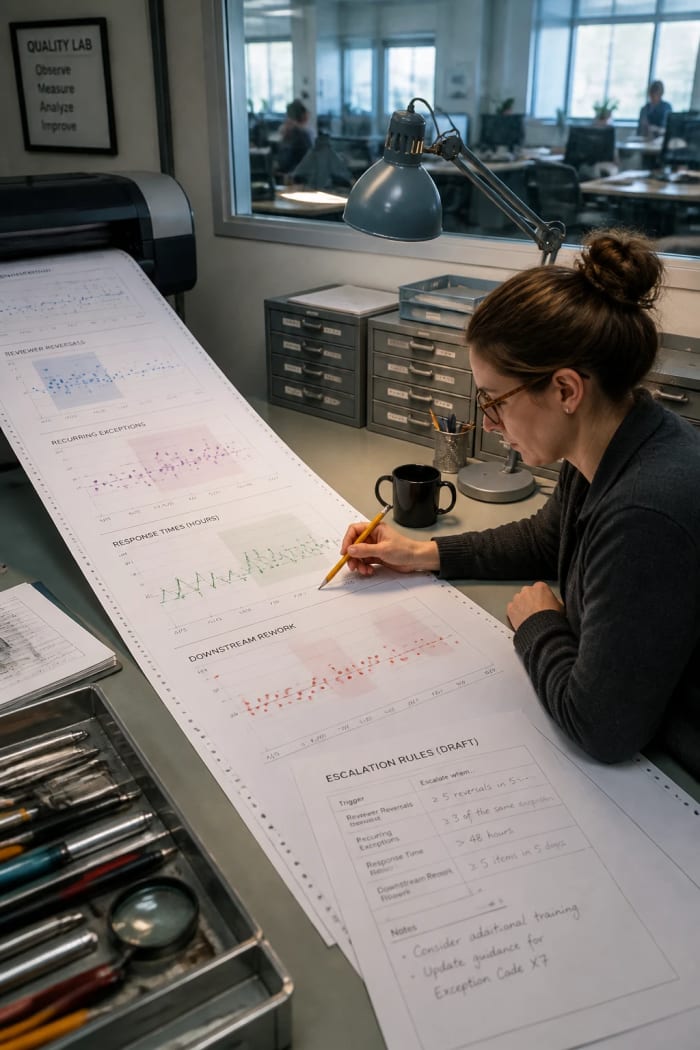
Your team should track a small set of outcomes that connect review to operational consequences. The most useful measures show what the reviewer changed, why the item was escalated, and whether the decision led to rework later. A long queue alone does not prove that review is wasteful. It may show that the workflow is escalating too broadly, assigning the wrong reviewer, or presenting too little context.
- Count how often a reviewer reverses or materially changes an automated recommendation.
- Record the exception types that appear repeatedly across a month or quarter.
- Measure how long high-priority exceptions wait before an owner makes a decision.
- Review downstream rework, missed deadlines, or preventable errors tied to released outputs.
Use the findings to tune the workflow carefully. If reviewers nearly always approve a low-risk category, your team may narrow that gate or replace it with periodic sampling. If reviewers often catch missing documents or misrouted records, strengthen that rule and keep the review point in place. Improvement means moving attention toward real risk, not treating all human oversight as waste.
Oversight Is a Design Choice
The choice is not between fully manual work and a system that acts without supervision. Reliable operations use automation for speed, consistency, and follow-through, then place people where context and accountability are indispensable. This is particularly relevant when a workflow affects capture priorities, compliance activity, staffing commitments, or external communications. Each of those decisions has a different cost of error and should have a different review rule.
Blanket approval is usually a sign that the workflow has not been designed around actual risk. Full autonomy is often a sign that someone has mistaken a well-formatted output for a sound decision. Both approaches misallocate employee time. A deliberate review design makes the normal path faster while making the exceptional path safer.
Start with one recurring workflow where people are overloaded by routine checks but still surprised by important mistakes. Map the moment a bad result becomes costly, then place the review just before that moment. Give the reviewer the evidence and authority needed to decide. That small change often exposes where the real operational problem has been hiding.
What To Do This Week
Choose one workflow that currently has either too many approvals or no meaningful stopping point. Your team should list the actions that happen automatically, identify the first irreversible or high-risk action, and name the person accountable for that decision. Then review the last ten records that passed through the process. The patterns in those records will show where human judgment is being wasted and where it is missing.
Set three initial rules for that workflow: one ambiguity trigger, one risk limit, and one final-accountability gate. Keep the rules simple enough that an employee could explain them during a busy pursuit meeting. Document what evidence the reviewer needs and how quickly they must respond. After two weeks, inspect the exceptions and adjust only what the results support.
Three Sixty Vue’s Automation Systems service connects existing tools, routes information, handles everyday operational steps, and makes follow-through more reliable. This week, have your team bring one approval-heavy workflow and ten recent examples to a working session so you can define the first targeted review rule.