
The real cost of busy
Busy days feel productive because there’s constant motion, but motion isn’t the same as progress. The cost shows up as half-finished projects, delayed follow-ups, and a calendar full of meetings that don’t change what anyone does next. Owners feel it most because they’re the default “fixer,” so every interruption becomes a decision only they can make. After a few months, that turns into a business that works hard but still feels stuck. And stuck has a price: missed revenue now, and a team that stops believing plans will actually happen.
This matters more in 2026 because discovery and demand move faster than most small teams can handle. Over 80% of consumers search for local businesses online at least once a week, so even a modest improvement in responsiveness and follow-through can change your week. If your phone rings, your site gets visits, and your profile gets direction requests, you already have attention. The question is whether your operation can convert that attention into booked jobs and completed work. When it can’t, “busy” becomes the mask for a silent conversion problem.
It also shows up on the money side in a sneaky way: you can be paying for tools, staff hours, and maybe even a front desk, yet still losing jobs because the basics aren’t consistent. If a caller hits voicemail at lunch, or someone submits a form and waits two days, they don’t care that your team was “slammed.” They just move on. That’s why we treat execution as a growth system, not a personality trait. Hustle is finite, but a clean operating rhythm scales.
A day that feels familiar
Picture a normal Tuesday for a local service business with 8–15 people. The owner walks in planning to finalize a proposal, approve next week’s schedule, and review a job that’s running over budget. Then the phone starts: a customer needs to reschedule, a supplier is out of stock, a tech can’t access a gate, and a new lead wants pricing “right now.” By 11:30, the owner has handled 30 micro-decisions and hasn’t touched the three things that would actually move the business forward.
The afternoon doesn’t get better because the team is also reacting. Someone posts in Slack asking, “Who’s handling this?” Another person asks, “Is this the priority today?” A third starts the task anyway, then stops halfway because they don’t want to do it wrong. Everyone is trying to be helpful, but the day becomes a chain of interruptions that fragment attention. In the end, you have a lot of activity and nothing shippable.
Here’s the tell: when you ask, “What did we complete today that we can point to?” the answers sound like effort, not outcomes. “We talked to the customer.” “We looked into it.” “We started.” Those aren’t bad things, but they’re not deliverables.
If your day is mostly reacting, your business is being run by the loudest input—not the most important outcome.

Stealth drain: reactive communication
Reactive communication is when messages become everyone’s highest priority by default. Calls interrupt estimates, emails interrupt job costing, and “quick questions” interrupt deep work that requires concentration. The worst part is that it feels customer-friendly, because you’re responsive in the moment. But it quietly steals the only resource you can’t buy back: uninterrupted time. Over weeks, that turns into a business where important work only happens after hours, which is how burnout becomes “normal.”
Inbound phone calls are the biggest driver of this drain for local service businesses. Calls don’t wait, and when no one answers, you create a second wave of work: voicemails, call-backs, missed context, and sometimes angry customers. Even when you do answer, the call often turns into a live triage session that drags the owner into the weeds. The fix isn’t “stop taking calls.” The fix is to stop letting every call re-plan your day.
A practical move is to create two response modes: “fast capture” and “scheduled resolve.” Fast capture means you collect the name, need, location, and preferred time, then you get back to them in a defined window. Scheduled resolve means you batch the actual decisions into set blocks, like 11:30–12:00 and 4:00–4:30, so calls don’t carve your day into confetti. Customers usually accept this if you’re clear and reliable. What they hate is silence and inconsistency, not boundaries.
- Fast capture: take the essentials, promise a specific follow-up window, and log it in one place.
- Scheduled resolve: make decisions in two daily blocks so the rest of the day can produce deliverables.
- Owner filter: only escalate calls that truly require an owner decision, not general scheduling or status checks.
Stealth drain: unclear ownership
Unclear ownership is when a task is “someone’s job” but not “one person’s job.” It shows up as group messages, shared inbox chaos, and projects that bounce between people with good intentions. The result is predictable: delays, duplicated work, and last-minute panic because nobody feels responsible for the finish line. It also trains the owner to hover, because hovering is the only way anything gets completed. That’s not leadership—it’s survival mode.
The simplest way to spot this is to listen for certain phrases: “I thought you were doing it,” “I was waiting on them,” or “We’re still figuring that out.” In a small business, those phrases are expensive because you don’t have layers of redundancy. If one job gets stuck, it blocks scheduling, cash flow, and customer communication. And when customers feel uncertainty, they lose confidence fast.
Single-threaded ownership fixes this without adding bureaucracy. One person owns the outcome, even if multiple people contribute to the work. Ownership means they’re responsible for moving it forward, clarifying questions, and calling a decision when needed. It doesn’t mean they do every task; it means they’re accountable for “done.” Once ownership is clear, the owner can stop being the default project manager.
To make it real, we recommend writing ownership in plain language next to any active project: “Jess owns it.” “Marco owns it.” If it’s a customer-facing promise, name the owner and the deadline in the same sentence. The goal is to remove the social awkwardness of accountability by making it normal. When everyone knows who owns what, work moves with less chatter.
Stealth drain: priority soup
Priority soup is what happens when everything is important, so nothing is. The day starts with a plan, then a new fire appears, and the plan gets replaced without anyone saying it out loud. By Friday, people are exhausted and can’t explain what changed or why. That’s not a discipline problem—it’s a design problem. Your business doesn’t have a mechanism for protecting the few moves that create progress.
This drain is especially common when you’re trying to grow. You’re juggling hiring, training, customer requests, vendor issues, and maybe a new service line or location. If you don’t pick a small number of weekly outcomes, you end up with a giant to-do list where the urgent pushes out the valuable. Everyone stays busy because there’s always something to react to. But the things that would reduce future chaos—process, training, system clean-up—never get finished.
We like a simple rule: if you can’t say the week’s goal in one sentence, you don’t have one. That sentence should describe a measurable result, not a vibe. “Improve scheduling” is a vibe; “reduce missed appointments from 6/week to 2/week” is a result. When the goal is clear, you can say no faster and you can delegate without fear. And your team stops feeling like the plan changes because of whoever yells the loudest.
- One weekly goal: the single outcome that matters most this week.
- Three measurable outputs: the concrete deliverables that prove you’re moving toward the goal.
- One must-decide-today decision: the choice that prevents tomorrow from becoming another reactive mess.
Switch to outcomes-first rhythm
Outcome-based work is when you measure progress by completed deliverables, not hours spent or messages sent. That sounds obvious, but most small businesses accidentally run on activity because activity is visible. You can see a full inbox, a packed calendar, and a busy shop. What you can’t see is whether the week’s most important result is actually getting closer. An outcomes-first rhythm makes that invisible part visible again.
Start with a weekly 30-minute planning meeting that ends with a written one-sentence goal. Then list three outputs that will be done by Friday, with an owner and a definition of what “done” means. This isn’t a corporate process; it’s a way to stop renegotiating priorities every morning. When you do this consistently, the team knows what to protect, and you can feel the anxiety drop. People work better when the finish line is stable.
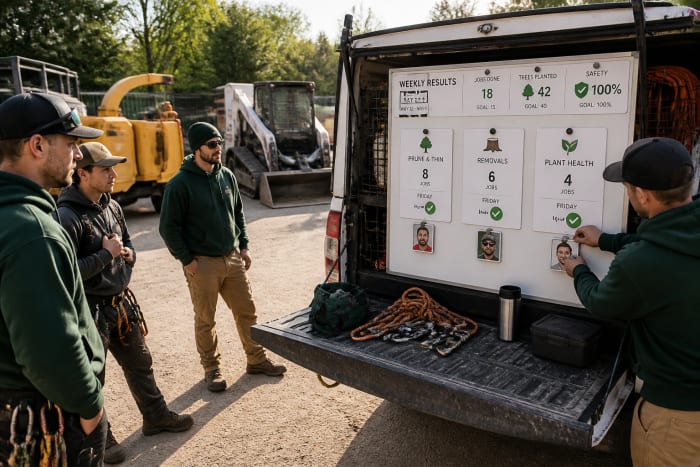
Once you run this rhythm for a few weeks, the benefits compound. You don’t just complete more—you complete the right things. That’s the shift from feeling busy to feeling in control. And control is what gives you the space to grow without breaking your team.
Execution guardrails that stick
Guardrails are small rules that keep work from sliding back into chaos. You don’t need a full operating manual; you need a few agreements everyone follows. The goal is to make “done” predictable, so projects don’t stall at 80%. Guardrails reduce the number of decisions you have to make in the moment. That’s how you protect your attention and your team’s momentum.
First: define “done” before work starts. Done isn’t “we talked about it” or “it’s mostly finished.” Done is something you can hand to a customer, put on the schedule, publish, or bill. Second: keep ownership single-threaded so one person can drive the work to completion. Third: make meetings earn their time by turning them into decisions, not updates.
- Definition of done: write the finish line in one sentence before anyone starts.
- Single-threaded ownership: one person is responsible for moving it forward and calling it complete.
- Meeting-to-decision rule: if a meeting ends without a decision and a next step, it wasn’t a meeting—it was a chat.
- Interruptions by design: batch non-urgent questions into two windows so deep work can exist.
Most “busy” businesses don’t need more effort. They need fewer open loops.When these guardrails are in place, you’ll notice something immediately: the owner’s day gets quieter. Not empty—just quieter. And in that quiet, real leadership work finally fits: hiring decisions, pricing, quality control, and the improvements that make next month easier than this month.
Turn visibility into booked work
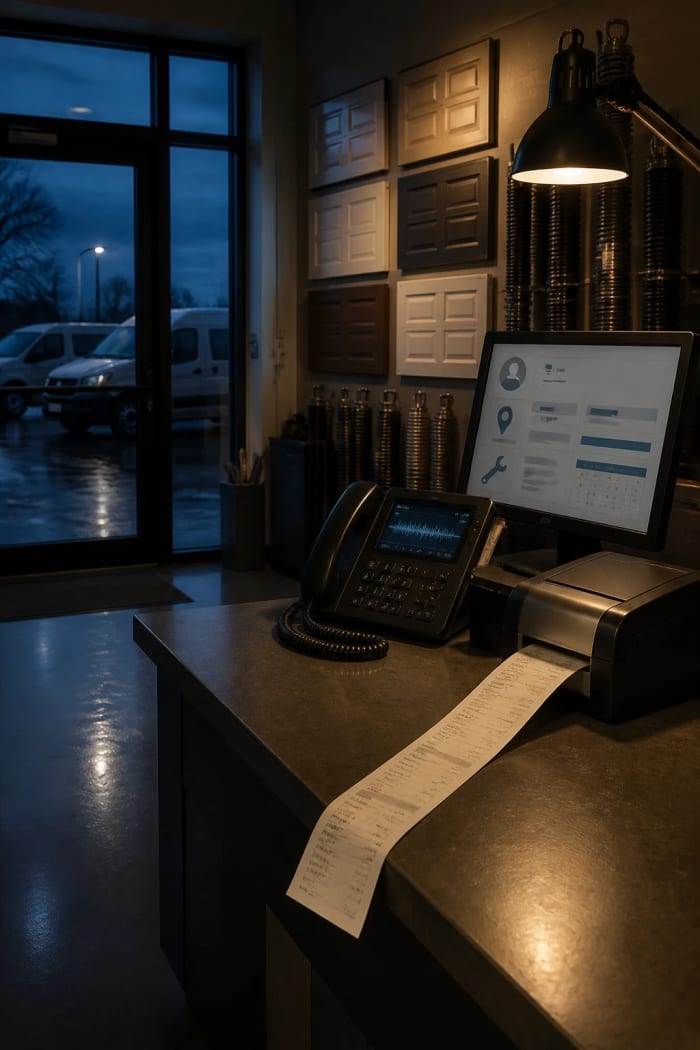
There’s a second reason businesses feel busy but don’t progress: leads come in inconsistently and get handled inconsistently. Someone finds you, calls, gets voicemail, and you spend the next day playing phone tag. Another person clicks your site, can’t tell what to do next, and you never even know they existed. That creates a brutal loop: the team works harder to “catch up,” but the inputs are messy, so output stays messy. Fixing execution means fixing intake and follow-through.
In 2026, local discovery is increasingly multi-surface. People still use Google heavily, but they also find businesses through Apple Maps, Bing, and AI answer engines that recommend “the best near me” without showing ten blue links. Some platforms even emphasize real-time accuracy, like whether you’re open at the time of the search, which means sloppy hours can literally push you down the list. That’s not a marketing trivia detail—it’s an operational detail with revenue attached. When your information and responsiveness are consistent, your day gets calmer because fewer situations turn into emergencies.
This is also where your website needs to do its job. A website shouldn’t just look nice; it should convert visits into calls and form fills. A “good” conversion rate for a small business is often described as above 10%, while top performers cluster around 5.31%+ for the top quarter and 11.45%+ for the top 10%. The point isn’t to obsess over a benchmark—it’s to recognize that small improvements can mean real money without adding more traffic. It’s like having a full parking lot but nobody walking through the front door; the fix is usually in the path from interest to action.
What to do this week
If you want a fast reset, don’t start by buying another tool or rewriting your whole process. Start by choosing one weekly goal for next week and writing it as a measurable result. Then pick three outputs that prove you’re moving toward that goal, and assign each output a single owner. Finally, choose one “must-decide-today” decision you’ll make every day before lunch. That alone will reduce the feeling that the day is running you.
Next, audit your interruption flow for one week. Notice how many times the owner gets pulled into scheduling, status requests, or repetitive questions that could be captured and handled in batches. If you can’t stop the interruptions, at least contain them with two daily windows and a “fast capture” script for inbound calls. Your team will feel the difference immediately because they’ll get longer blocks of time to finish things. Finishing creates confidence, and confidence creates speed.
If inbound calls are a major source of chaos, we can help directly. Our AI voice receptionist answers inbound phone calls for your business, captures the caller’s details, and routes messages so your team isn’t forced into constant live triage. If repetitive admin work is eating the owner’s day, our AI automation connects your existing tools so routine steps happen automatically instead of by hand. And if your website is contributing to phone tag and low-quality leads, our custom website design builds a site that ranks in local search results and guides visitors toward clear next steps.
Take one action this week: pick your weekly goal and three outputs today, then decide whether calls are interrupting execution enough to justify an AI voice receptionist. If the answer is yes, reach out to us and we’ll map a simple call flow you can implement without disrupting your team.